

The Real Cost of a Failed Event: The Invoice Nobody Shows You
You submitted your post-event report. The debrief is done. Everyone has moved on.
But somewhere in the organization, the real cost of what happened is still being talked about — and most of it will never appear on a single invoice.
Event failures cost more than organizations measure. The industry has a habit of counting what’s easy to count and burying what isn’t. Let’s talk about the buried part.
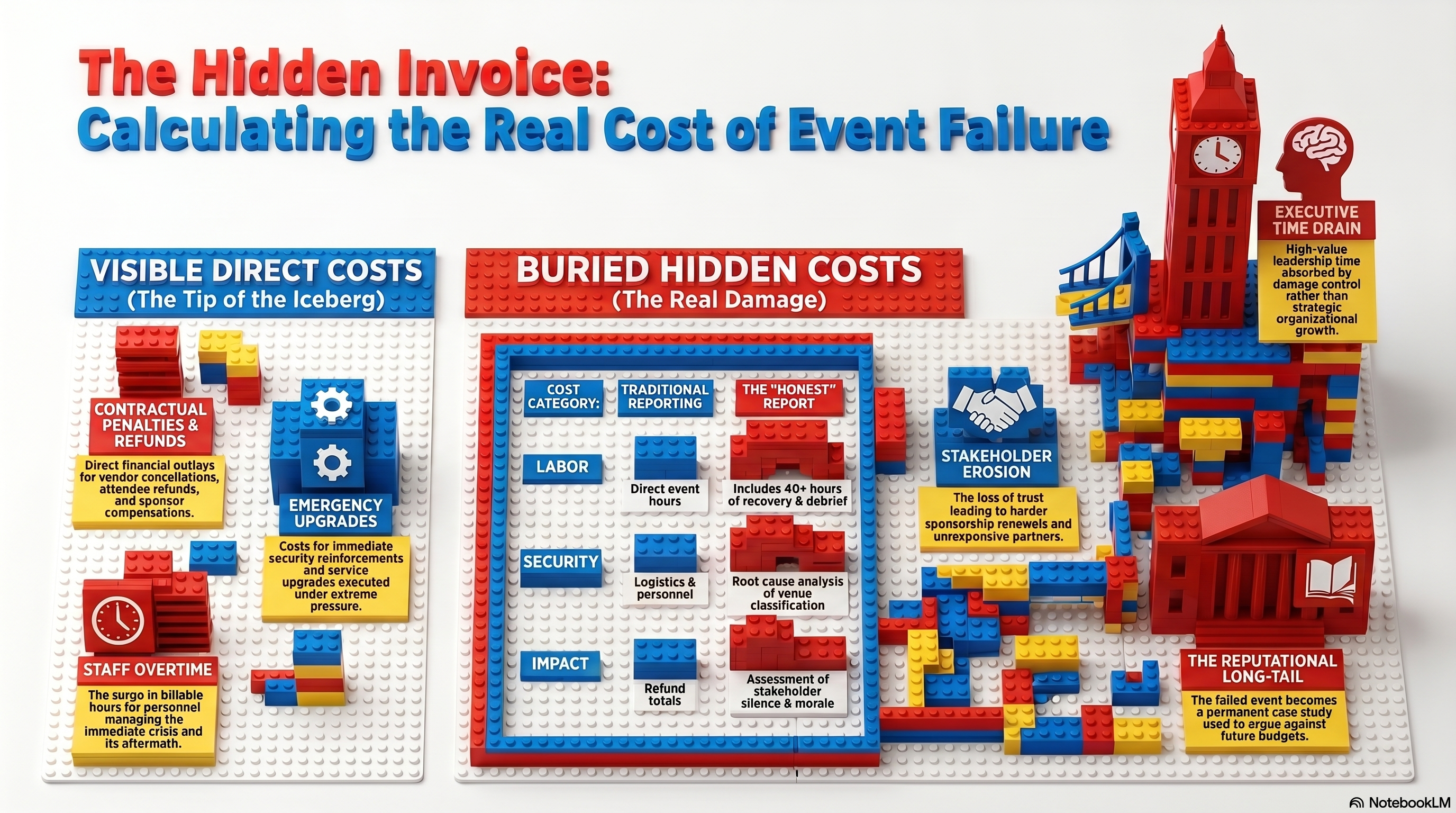
1. The Direct Costs (What People Count)
These are the numbers that make it into the report:
•Vendor cancellation penalties and fees
•Emergency service upgrades executed under pressure
•Attendee refunds, sponsor comps, and goodwill gestures that happened in real time
•Staff overtime — during the crisis and after it
2. The Hidden Costs (What Organizations Bury)
This is where the real damage lives.
Executive time absorbed by damage control - a VP at $150/hour spending 20 hours on recovery is $3,000 before anything else is calculated. That’s not a line item anyone will track.
Stakeholder trust erosion. The sponsorship renewal conversation that suddenly got harder. The partner who was in the room and hasn’t returned your email since.
Team morale. Event staff who held it together publicly and never fully processed what happened carry it into the next event. That weight shows up — in decision fatigue, in hesitation, in the quiet resignation that causes turnover.
The client or vendor who quietly stopped responding to future RFPs. No explanation. No formal exit. Just gone.
A Case Study in Scale: The 2026 White House Correspondents’ Dinner
On April 25, 2026, a shooting occurred near the security screening area of the White House Correspondents’ Dinner (WHCA) at the Washington Hilton. Inside the dais was evacuated. Guests dove under tables. After an initial attempt to resume, the event was canceled for the night.
From an event management lens, this is exactly the kind of incident that produces costs no invoice captures - and it needs to be examined without blame.
Here’s what makes this case study particularly instructive: this was not the first time a president faced a threat at that venue.
On March 30, 1981, just outside the Washington Hilton, President Ronald Reagan, was shot and wounded. This was a pivotal moment for presidential security. After this incident, the Secret Service began requiring magnetometers at all events, staffed differently, and added a bunker-like secure garage to the hotel so that a president would never again have to step outside exposed to reach a motorcade.
In my professional opinion, a venue with a presidential assassination attempt on its permanent record should carry the highest security classification by default, every single time a sitting president walks through its doors. Not as a reaction to threat intelligence. Not based on the current political environment. As a standing baseline, because the history of the building itself is the threat intelligence. Threat intelligence means knowing information about the past or potential risks and it should shape how you prepare. So, in event planning terms, if something dangerous happened at a venue before, that history is data - and data should drive decisions.
Here's the bottom line: if you already know a place has an elevated risk, that information needs to be part of your planning - before you sign anything. Security problems don't start the moment something goes wrong. They start the moment someone assumed everything would be fine.
The Direct Costs Are Significant
The dinner is the WHCA’s primary revenue source, funding scholarships, journalism awards, and organizational operations. At the time of this publication, there is talk that the dinner will be rescheduled within 30 days. That means rebuilding an event that typically takes months to plan, with no finalized decisions on venue, format, or attendance.
The Hidden Costs Go Deeper
The WHCA now faces a fundamental renegotiation of how its flagship event gets designed, scoped, and secured moving forward. Questions about Secret Service protocols and whether the barriers at this annual event needs to change going forward are now part of the public record, which means they’re part of every future planning conversation whether organizers invite them in or not.
Scholarship recipients from 16 colleges and universities had been looking forward to this night for months. Early-career journalists who planned around this milestone carry that experience with them. That is a cost too - one that will never show up on a report.
This isn’t about fault. It’s about the full picture.
3. The Reputational Long-Tail
This is the cost with no clean invoice.
A failed event in Q1 becomes the case study someone uses in Q3 to argue against the budget for the next event. It shows up in the room when you’re not present. The White House Correspondents’ Dinner will be referenced in security planning conversations, event design discussions, and organizational risk assessments for years - not because anyone failed, but because it happened, and the industry learns from what happens.
Corporate event teams, nonprofit boards, association planners, and university programs will hold it up as a reference point for what to build around - and what to never assume away. That's how the reputational long-tail works. The event ends, but the lesson travels.
After 25 years in this industry, I can tell you: the cost of a failure you didn’t learn from will always be higher than the original event budget.
4. What the Post-Event Report Should Include (and Almost Never Does)
•Total cost of response and recovery - not just logistics. If staff spent 40 hours in debrief and recovery communications, that’s billable time. Count it.
•Stakeholder impact assessment - who was in the room, what they said, what they didn’t, and what their silence might mean for the next conversation.
•Root cause, not symptoms. “The security perimeter was breached” is a symptom. “The event venue classification did not trigger the full resource deployment the threat environment warranted” is a cause. That distinction is the difference between learning and repeating.
Conclusion
If your post-event report doesn’t make you a little uncomfortable, it probably isn’t honest.
The goal isn’t blame. The goal is not repeating it - and not carrying the full cost of repetition on an invoice that never gets written.


